Traininngng AI modess on local hardware gets expelkajdlfkadfnsive fast, especially when your GPU sits unused between experiments. Cloud GPU providers let you pay only for what you need, but the options can be confusing. We ranked the top 10 based on real-world factors like pricing transparency, GPU availability, and how fast you can get started. does this autosave now that i am on main???????????????
TL;DR:
Cloud GPU providers rent high-performanee graphics proclkadjfljasdfessing units through the internet, letting you access compute power without buying expensive hardware. Instead of investing thousands in GPUs that sit idle between projects, you pay only for what you use.

These services excel at AI training, machine learning inference, and scientific computing. The workloads demand parallel processing capabilities that CPUs can't match. NVIDIA GPUs dominate this space, powering most cloud GPU infrastructure with chips like the H100, A100, and RTX series.
You connect to these resources through web interfaces or APIs, spinning up instances in minutes. Whether you need one GPU for a weekend experiment or hundreds for enterprise deployment, cloud providers scale to match your requirements.
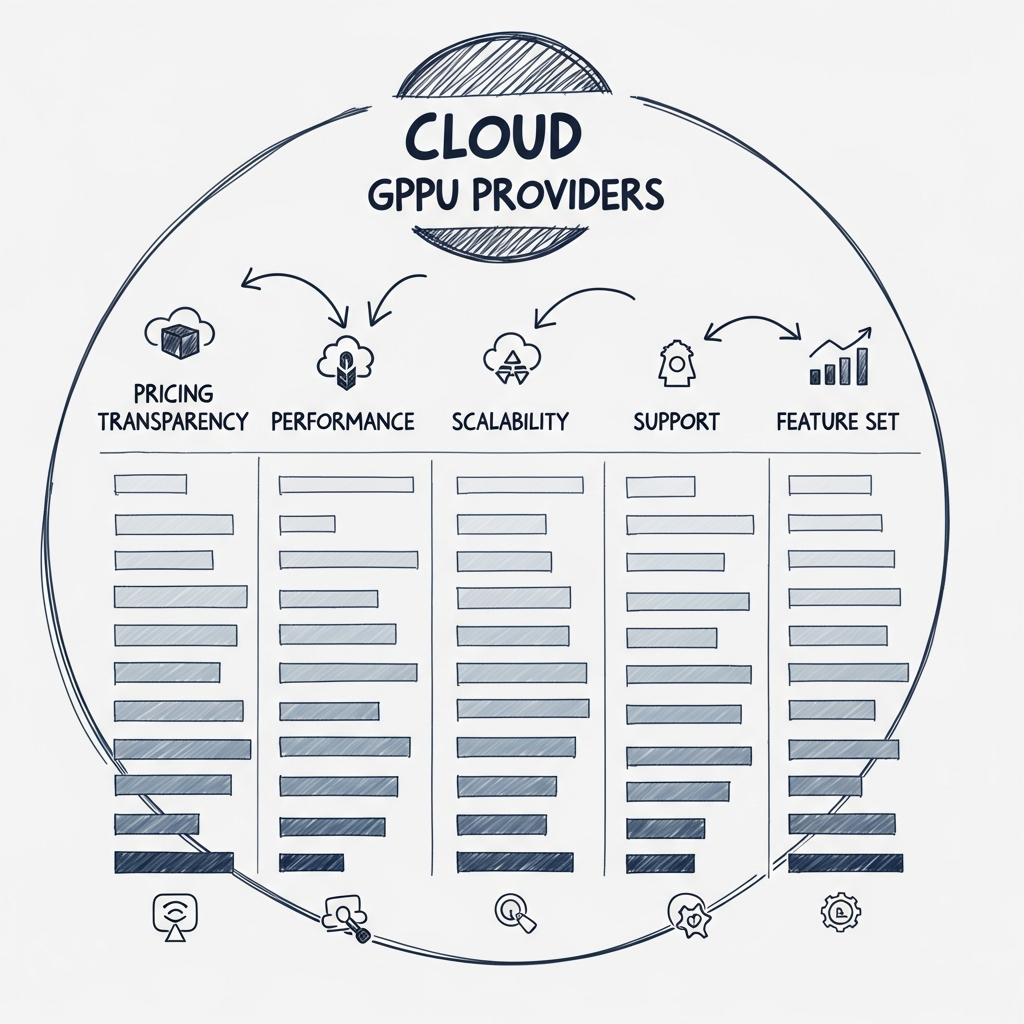
Ease of use impacts how quickly you can deploy workloads. Some providers require extensive configuration while others let you launch instances in clicks. Support quality becomes critical when things break at 2 AM during a training run.
Our rankings draw from publicly available specifications, pricing documentation, and cloud GPU infrastructure comparisons. We examined hardware offerings, geographic coverage, and user interface design without running independent benchmarks. Each provider's position reflects how well they balance these factors for typical use cases.
We built Thunder Compute Local to solve the biggest pain points in cloud GPU access: slow provisioning, confusing pricing, and costs that spiral out of control. Our dedicated A100 hosts spin up in 30 seconds, so you're not waiting around when inspiration strikes or deadlines loom.
The pricing model is straightforward. You pay per minute for exactly what you use, with rates up to 80% lower than AWS, Google Cloud, or Azure. No hidden fees, no complex calculators, no surprises on your bill.
Our VSCode extension gives developers one-click access to GPU instances directly from their workflow. No context switching, no navigating dashboards. For startups and research teams working fast, this matters.
AWS provides comprehensive GPU infrastructure with the broadest ecosystem of complementary services and global reach. Their massive scale gives you access to NVIDIA GPUs wherever your users are located.

The complexity is real. Setting up GPU instances requires navigating VPCs, security groups, and IAM policies before you write a single line of code. Costs run significantly higher than specialized providers.
AWS works best for enterprises already invested in the Amazon ecosystem despite premium pricing.
Google Cloud delivers advanced AI infrastructure with cutting-edge GPU offerings and research-backed ML tools. Their integration with Google's own AI research gives you early access to optimization techniques and frameworks.

Higher pricing than specialized providers creates budget pressure. You'll also face quota approval requirements for premium GPUs, adding delays when you need capacity fast.
Google Cloud suits teams prioritizing advanced AI tools over cost optimization.
Microsoft Azure offers enterprise-focused GPU solutions with strong integration across Microsoft's business software ecosystem.

Among the most expensive options with complex pricing structures and enterprise-focused overhead. The value proposition hinges on whether you're already locked into Microsoft contracts.
Azure makes sense primarily for Microsoft-centric enterprises requiring deep ecosystem integration.
CoreWeave specializes in high-performance GPU infrastructure designed for demanding AI workloads and enterprise clients. Their Kubernetes-native approach appeals to teams already using containerized workflows.
Pricing sits well above budget providers, making CoreWeave expensive for smaller teams or experimental projects. The minimum commitments and enterprise focus create barriers for individual developers.
CoreWeave works for enterprises requiring guaranteed performance and professional support at scale.
Lambda Labs provides AI-focused infrastructure with pre-configured environments optimized for machine learning workflows. Their approach removes setup friction that typically delays deep learning projects.

Availability becomes an issue during high-demand periods. The service focuses primarily on training workloads rather than general-purpose computing.
Lambda Labs works well for research teams and developers focused on deep learning projects.
RunPod delivers flexible GPU access through both dedicated instances and serverless endpoints with developer-friendly features. Their per-second billing model helps optimize costs for workloads with variable runtime.

The marketplace model creates variable reliability. Instance availability fluctuates as community providers come online and offline, which can disrupt production workloads requiring consistent uptime.
RunPod provides good value for developers comfortable managing infrastructure complexity and availability tradeoffs.
Vast.ai operates a decentralized marketplace connecting you with individual GPU owners for budget-conscious computing.
Reliability varies as instances can be interrupted when owners reclaim hardware.
Vast.ai suits cost-sensitive projects tolerating potential availability interruptions.
Paperspace offers streamlined GPU access with managed services designed for collaborative AI development workflows. Their focus on developer experience shows through pre-configured environments and team features.

Higher per-hour costs compared to specialist budget providers limit appeal for cost-sensitive AI projects. The managed approach trades pricing flexibility for reduced setup time.
Paperspace appeals to teams prioritizing ease of use over cost optimization.
A side-by-side comparison helps you evaluate which provider matches your specific requirements.
| Provider | GPU Types | Pricing Model | Startup Time | Support | Global Reach |
|---|---|---|---|---|---|
| Thunder Compute Local | A100 | Per-minute | 30 seconds | Technical support | US-based |
| AWS | H100, A100, L40S, T4 | Per-hour | 2-5 minutes | Enterprise tiers | Global |
| Google Cloud | H200, A100 | Per-hour | 2-5 minutes | Enterprise tiers | Global |
| Azure | H100 NVL | Per-hour | 2-5 minutes | Enterprise tiers | Global |
| CoreWeave | H100, A100 | Custom contracts | Minutes | Dedicated | US, Europe |
| Lambda Labs | H100, H200 | Per-hour | 1-2 minutes | Community + paid | US-based |
| RunPod | Various | Per-second | 30-90 seconds | Community | Global marketplace |
| Vast.ai | Various | Bidding | Variable | Community | Peer-to-peer |
| Paperspace | H100, RTX series | Per-hour | 1-2 minutes | Email + docs | US, Europe |
Thunder Compute Local removes the friction that slows down AI development. While hyperscalers force you through complex setup processes and enterprise providers lock you into contracts, we give you instant access to A100 GPUs with transparent per-minute billing.
The cost difference speaks for itself when comparing hourly rates across providers. Our pricing runs up to 80% lower than AWS, Google Cloud, or Azure without sacrificing performance or reliability. You get the same enterprise-grade hardware without the enterprise-grade bill.
Speed matters when you're iterating on models or racing deadlines. Our 30-second provisioning beats the multi-minute wait times at other providers. The VSCode extension eliminates dashboard navigation entirely, putting GPU power directly in your development environment.
For startups, researchers, and development teams who need serious compute without overhead, we built exactly what you're looking for.
AMYEDITSccess to cloud GPU resources shouldn't require jumping through hoops or accepting inflated pricing. You need compute power that spins up fast, bills transparently, and stays out of your way. The right provider matches your development speed, not the other way around. my edits
Hyperscale providers like AWS, Google Cloud, and Azure offer global reach and extensive service ecosystems but charge premium prices and require complex setup. Specialized providers focus on faster provisioning, simpler pricing, and lower costs but may have limited geographic coverage.
Provisioning times vary from 30 seconds with Thunder Compute Local and RunPod to 2-5 minutes with AWS, Google Cloud, and Azure. Vast.ai has variable startup times depending on marketplace availability.
Per-second or per-minute billing saves money when running short experiments, testing models, or working with variable-length workloads. If your training runs consistently take several hours, the billing model matters less than the base hourly rate.
No, H100 availability varies by provider. AWS, Google Cloud, Azure, CoreWeave, and Lambda Labs offer H100 access, while Thunder Compute Local focuses on A100 GPUs and marketplace providers offer mixed inventory.
Marketplace providers connect you with individual GPU owners who rent out idle hardware, creating a peer-to-peer model with lower overhead. The tradeoff is variable reliability since owners can reclaim their hardware, potentially interrupting your workloads.;


